
Restore a forgotten neighbourhood, one cozy room at a time.

Hozy is a new cleaning-and-decorating sim from publisher tinyBuild and first-time developer Come On Studio. Out now, this highly anticipated cozy game is the perfect space to wind down and enjoy the simple act of making spaces beautiful again.
The game begins with you returning to your small hometown, and yeah — it’s seen better days. Faded. Forgotten. A little sad around the edges. But in that stillness, you discover something unexpected — a new passion. Room by room, space by space, you clean, paint, and gently restore the sense of community that once filled these streets.
No timers. No scores. No penalties. Just you, your tools, and the quiet satisfaction of watching grime disappear under a squeegee. So does Hozy deliver on that cozy promise? Let’s grab a mop and find out.
Let’s Clean, Paint and Decorate
The core gameplay loop of Hozy breaks down into three clear stages: clean the space you’re in with a variety of tools, paint the area, and then feel free to decorate as you see fit.
Clean. Grab your mop and go to town on those floors. Scrub windows until they gleam. Rip out rotten floorboards with your crowbar. Sweep leaves off a forgotten patio. The physics here are genuinely pleasant — your mop leaves visible wet tracks that dry over time. Paint glistens fresh on walls before settling. It’s small stuff, but it lands in a deeply satisfying way.

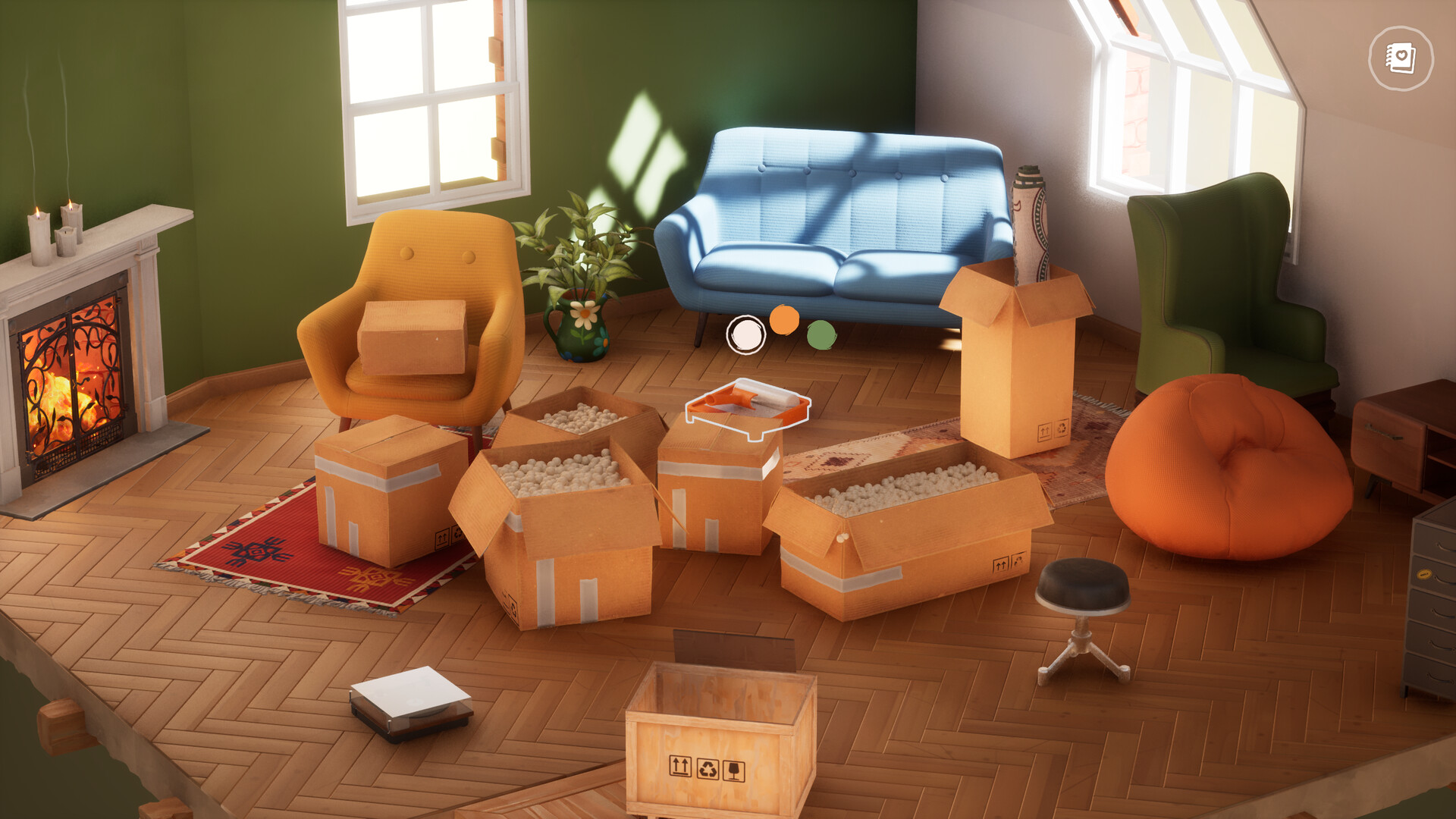
Paint. Each room offers a limited palette — usually three color options per wall. Not overwhelming. Just enough to shift the vibe from “abandoned” to “someone cares about this place.”
Decorate. This is where Hozy gives you room to play. Each level offers a curated selection of furniture and décor that actually works together. Place items anywhere. Rotate freely. Stack books on shelves. Light candles. Fire up an old projector. Toss a rug in that bare space. There’s no “wrong” placement and the game never punishes you for putting the couch in a weird spot.
Hozy is about the little things

Hozy excels at the tiny stuff. Open a window, and a breeze rustles the curtains while dust motes dance through sunbeams. Turn on a fan — there’s that soft background hum. Plants sway. Pillows sag realistically when you grab them. Textures shine too. Paint rollers leave visible texture on walls. Wood grain shows through on floorboards. You can tell that the visuals and sound are a labour of love in the game.
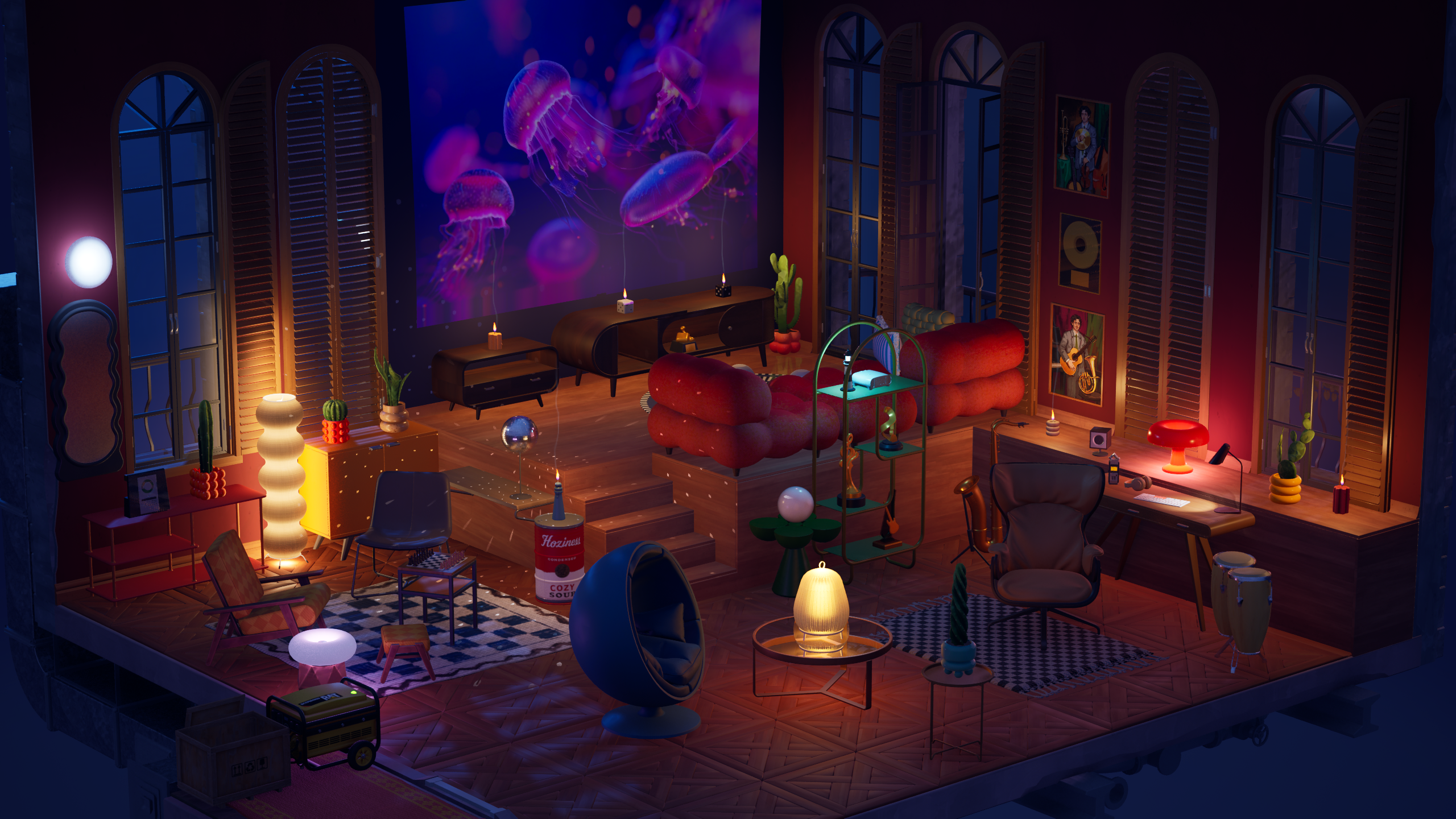
Hozy runs on a semi-realistic style that sits somewhere between a cozy illustration and a high-end interior design mood board. The lighting is the real star — sunlight pours through freshly cleaned windows with a warm, hazy quality that makes you want to just stand in it. Dust motes catch the light when you open a window. Shadows fall naturally. It’s the kind of visual polish which brings you into the world.

The sound design carries a lot of weight here. Yann Van Der Cruyssen — the composer behind Stray and Seasons After Fall — built a dynamic soundtrack that evolves as you make progress. Start a bare room, and the music is hesitant, almost shy. Add furniture, let the light in, and the track blooms around you like the room itself is waking up.
I caught myself just standing in a finished room once or twice, listening. That’s the sign of a cozy game doing its job.
Nine Rooms, Each With Its Own Personality

Hozy serves up nine unique spaces, and credit where it’s due — they put real thought into variety. You’re not just cleaning the same apartment nine times with different wallpaper.
From your first dusty home, heavy with nostalgia, you’ll move through an artist’s workshop cluttered with creative chaos and half-finished projects, a charming cafe that still smells faintly of coffee and old memories, a treehouse that feels like a childhood dream finally realised, an attic and more.
Each space introduces small mechanical variations to keep things interesting. In one apartment, you’ll need to interact with furniture to uncover hidden rubbish. In another, opening and closing shutters becomes part of the renovation process. One level had me covering up gorgeous brick, and it hurt me to my core — but hey, that’s what the client wanted.
These touches are subtle, but they go a long way in making each level feel distinct rather than reskinned.
The aesthetics shift noticeably between levels, too — not just in the spaces themselves but in the items you place. Some rooms lean cutesy and young. Others feel edgy, expensive, almost melancholic. Everything was designed with purpose, and it shows.
Where Hozy Starts to Creak
Alright. Let’s talk about the stuff that kept this from a higher score. Because there’s a “but” coming, and it’s a decent-sized one.

The camera controls are genuinely awkward. On mouse and keyboard, the view feels rigid, like it’s fighting you just a little. On the controller, it’s almost too fluid — the camera swings around like it’s had too much coffee. You’ll adapt after a room or two, but it’s a friction point that shouldn’t be there. (The devs have noted they’re still tweaking this, so future patches may help.)
The unpacking system is clunky. You have to pull every item out of the boxes in order, including a discard box. Want that lamp you tossed early because you changed your mind? Too bad. You’ll need to pull out everything you placed after it first. With empty backgrounds surrounding each level, a dedicated inventory menu would have solved this cleanly.
There’s no real storyline to sink into. Each room has a brief description of who used to live there. Some items have small captions (a painting labelled “my sister”). But it never goes deeper. Compared to something like Unpacking, which told a full life story through objects alone, Hozy feels narratively hollow. You’re not learning about the people who lived here. You’re just… cleaning.
And honestly? That might be fine for some players. But I kept waiting for a thread to pull, and it never came.
Replayability Issue
You Only Need To Play It Once

Here’s where I start to feel conflicted. You have a lot of freedom in how you place items within a room. That part is genuine. But those freedoms end there. Paint options cap at three per wall. Alternate flooring only appears if the room specifically tasks you to replace the floor. You’re stuck with a handful of specific items per room, no mixing across levels.
The limitation in decoration, plus its fairly short runtime of about 2-3 hours, makes me hesitant to recommend this game at full price, and I’m doubtful that I’d be replaying it anytime soon. Here’s the thing about short games: they can absolutely work. Some of my favourite experiences are over in an afternoon. But a short game needs something to pull you back in — a reason to revisit those spaces, to try a different approach, to see what you missed the first time.

And that’s where Hozy stumbles.
Of course, this can be changed with updates such as new decoration levels, seasonal updates and even a ‘create’ or free ‘sandbox mode’ where things are less limited and you can use all items and paint colours. That alone would add strong replayability and encourage experimentation. Without it? You’ll rearrange a room once, maybe twice, before you’ve exhausted its possibilities.
It’s a shame, because the bones are so good. The visuals are stunning. The physics are satisfying. The soundtrack is lovely. But the lack of substance makes it feel more like an interactive tech demo — a gorgeous, polished tech demo that shows exactly what Come On Studio can do, but a tech demo nonetheless.
Hozy
Hozy nails what it does well. The visuals are stunning. The physics are deeply satisfying. The soundtrack is a genuine highlight, and the dynamic layering as you make progress is a lovely touch. For 2-3 hours, it’s a genuinely pleasant place to exist. But it’s hard to ignore how much more this could have been.
There’s nothing inherently wrong with Hozy. Some of my favourite games are one-and-done experiences. But I need to be honest about what you’re getting. Whether it’s worth fifteen bucks is entirely up to you.
As it stands, Hozy is a cozy appetiser. A beautiful one. Just don’t expect a full meal.
Score: 3.4/5
Platforms: Steam Deck, PC, Mac
Release Date: March 30th 2026

